
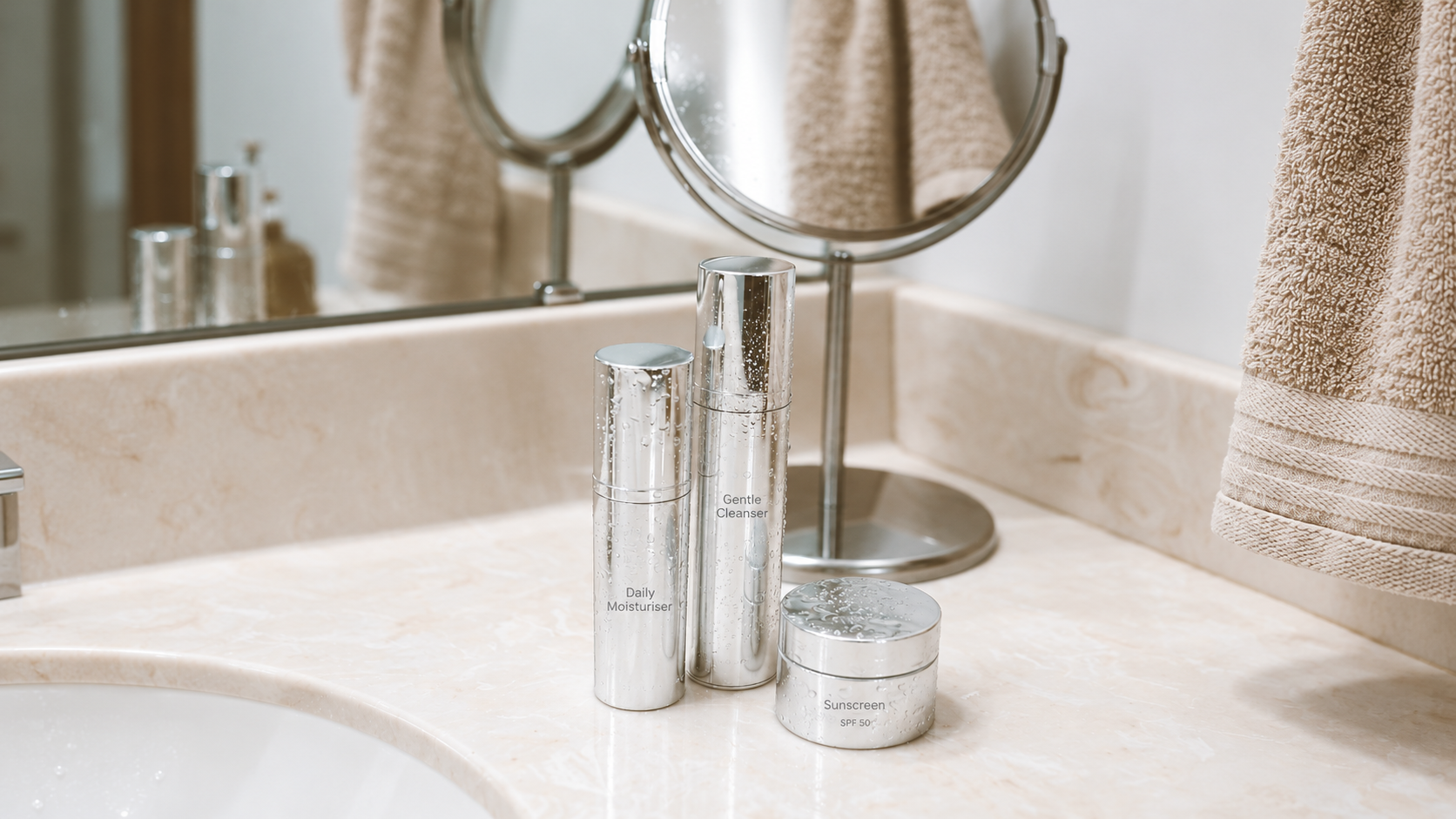
Skincare can become complicated very quickly. A cleanser leads to a toner, several serums and treatments—yet it may still be unclear what each product contributes.
A more useful starting point is to understand three everyday tasks: removing unwanted residue, maintaining hydration and reducing sun exposure. These form the foundation of a simple routine. Extra products can then be considered for a particular concern, rather than added because a longer routine appears more effective.
The American Academy of Dermatology supports a basic approach built around cleansing, moisturising and sun protection. Effective skincare does not have to be expensive or involve many products.
Source: American Academy of Dermatology — Skin care on a budget
Start with the skin barrier
The outermost skin layer, the stratum corneum, helps regulate water loss and protect against environmental exposure. Its structure includes skin cells and surrounding lipids, notably ceramides, cholesterol and fatty acids.
This explains why skincare should do more than make the surface feel clean. A suitable routine also needs to respect the structures that help skin retain moisture.
Ceramides are important, but choosing a product is not simply a matter of finding that word on a label. Scientific research highlights the importance of how these ingredients are combined and delivered within the finished formulation.
Source: Schild and colleagues, 2024 — Ceramides, skin barrier function and formulation
Cleanse without scrubbing
Cleansing removes material that accumulates on the skin, including dirt, oil and product residue. The aim is to remove what is unwanted without adding avoidable irritation.
Use a gentle, non-abrasive cleanser and lukewarm water. Apply it with your fingertips, rinse thoroughly and pat dry with a soft towel. Scrubbing brushes, rough cloths and forceful rubbing are not necessary for an everyday routine.
Dermatology guidance generally recommends washing no more than twice daily, with additional cleansing after heavy sweating. Repeated washing throughout the day can be counterproductive if it leaves the skin irritated.
Comfort matters. A routine that repeatedly produces stinging or soreness deserves reassessment rather than persistence.
Source: American Academy of Dermatology — Face washing 101
Moisturise with a purpose
A moisturiser is a formulation designed to improve hydration and skin feel. Different ingredients contribute in different ways:
- Humectants help attract and retain water.
- Emollients soften and smooth the skin.
- Occlusive ingredients help reduce water escaping from the surface.
Many products combine these functions. This is why evaluating the complete formula is more useful than judging a moisturiser by a single fashionable ingredient.
A 2024 scientific review emphasised that, although ceramides contribute to barrier function, other components—including natural moisturising factors—also play important roles in hydration.
Source: Baldwin and Del Rosso, 2024 — Going beyond ceramides in moisturisers
Apply moisturiser after cleansing while the skin remains slightly damp. Oily skin may still benefit from moisturising; a product labelled “non-comedogenic” or “won’t clog pores” may be an appropriate option. Choose a texture you find comfortable enough to use consistently.
Source: American Academy of Dermatology — Choosing a practical routine
What does recent research add?
Research continues to investigate whether particular formulations offer benefits beyond basic moisturising.
In a randomised, double-blind trial published online in October 2026, 60 adults with moderate atopic dermatitis received standard treatment alongside either a ceramide NP-containing cream or a placebo formulation.
Both groups improved. Several results numerically favoured the ceramide-containing cream, but differences between groups in changes to measured skin-barrier parameters did not reach statistical significance.
The study therefore does not establish a clear additional benefit for those measurements. Equally, it does not demonstrate that all ceramide products are ineffective. It tested one formulation in a small group of adults with eczema, not every moisturiser or routine use in healthy skin.
For consumers, the lesson is to look beyond ingredient headlines. Evidence needs to be interpreted in the context of the product tested, the participants and the outcomes measured.
Source: Gu and colleagues, 2026 — Ceramide NP moisturiser trial
Protect against the sun
Sun protection serves a different purpose from cleansing or moisturising: it reduces exposure to ultraviolet radiation.
For UK consumers, NHS guidance recommends SPF 30 or higher, alongside strong UVA protection. Look for at least a four-star UVA rating; a UVA-in-a-circle mark also indicates compliance with the relevant European UVA protection standard.
SPF describes UVB protection, so it should not be the only feature you check.
Apply sunscreen generously to exposed areas and follow its instructions. Reapply at least every two hours while outdoors, and after swimming, sweating or towel drying. Water resistance does not remove the need to reapply.
Sunscreen is one part of protection. Use shade, suitable clothing and a hat as well. In the UK, the NHS advises particular care between 11am and 3pm from March to October. A UV index of 3 or higher is another useful prompt to protect your skin.
Source: NHS — Sunscreen and sun safety
Why consistent protection matters
Some of the strongest evidence comes from research that followed people over years rather than days.
A randomised Australian trial involving 903 adults younger than 55 compared daily sunscreen use with discretionary use. After approximately four and a half years, the daily-use group showed less progression in the study’s measure of skin ageing.
The findings do not mean sunscreen prevents every aspect of ageing. They do provide direct evidence that regular protection can reduce measurable photoageing.
Published in 2013, this remains an important example of why the newest study is not automatically the most useful. Study design, follow-up and relevance matter alongside publication date.
Source: Hughes and colleagues — Sunscreen and prevention of skin ageing
Build a routine you can maintain
For an adult starting a basic routine:
Morning: cleanse gently as needed, moisturise and apply sunscreen before daytime outdoor exposure.
Evening: cleanse to remove accumulated residue, then moisturise.
If you use a prescribed skin treatment, follow the instructions provided by your clinician. The order and timing may need to accommodate that treatment.
Adding multiple treatments at once can increase irritation. Introduce further products for a clear purpose, rather than assuming every routine needs exfoliating acids, several serums or an eye cream.
Source: American Academy of Dermatology — Applying skincare products in order
Introduce new products carefully
Before using a new skincare product widely, the American Academy of Dermatology recommends trying a small amount on a limited area twice daily for seven to ten days. Follow the directions, including rinsing off products that are not intended to remain on the skin.
A small-area test may reveal an unwanted reaction, but it cannot guarantee future tolerance. It is also different from diagnostic patch testing carried out to investigate contact allergy.
Stop using a product if it causes a reaction. Seek professional advice for severe, persistent or recurring symptoms rather than repeatedly adding products to manage an unidentified problem.
Source: American Academy of Dermatology — Testing skincare products
The RayaMedPharm approach
Our approach is to start with a clear purpose for each step, choose tolerable products and assess claims against relevant evidence.
A useful routine should be understandable, manageable and suited to your skin. Cleanse gently, support hydration and take sun protection seriously—then consider additional care when there is a specific need.
This article provides general information for adults and does not replace individual advice from a qualified healthcare professional.
Evidence checked: 26 October 2026.


Add Comment